
SNG: Synthetic gas for the maritime transition

A viable path to decarbonization
MAN Energy Solutions is driving the maritime energy transition with technologies for low-carbon fuels, including green engines and retrofits. Our synthetic natural gas (SNG) solutions offer you a clear path to low-carbon shipping.
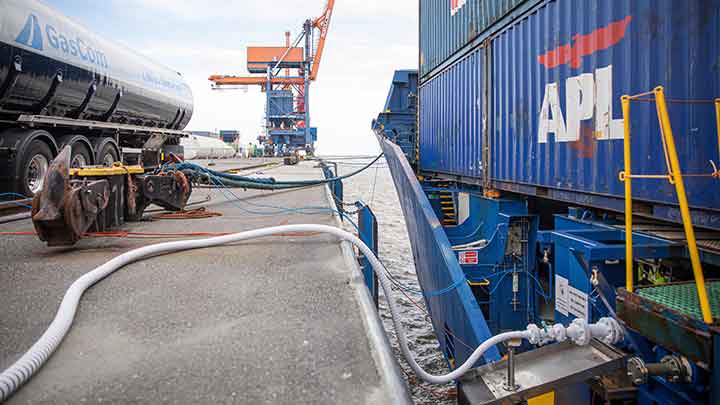
From HFO to LNG to SNG
Most of the world's ships run on heavy fuel oil (HFO). The climate crisis has made it essential to find low-carbon alternatives. In recent years, liquefied natural gas (LNG) has become the alternative of choice, but it still a fossil fuel that produces greenhouse gases (GHG). SNG is a new low-carbon alternative. SNG is chemically the same as the main combustible constituent of LNG, so it can used as a direct replacement or blended with LNG, depending on the supply.
SNG as maritime fuel
SNG is optimally suited for the two- and four-stroke dual-fuel engines in MAN’s range and ideal for ships that already run on LNG and aim to save additional emissions. Achieving fuel supply aboard ship is straightforward enough with the right equipment – as with LNG. The new gaseous fuel has to be held at cryogenic temperatures prior to bunkering (-162°C). However, an already established LNG infrastructure can also be used for fueling with SNG.
Reference case: ElbBLUE
World’s first use of SNG in commercial shipping
In September 2021, the 1,036-TEU vessel ElbBLUE, which had been retrofitted with a four-stroke MAN 51/60 dual-fuel engine in 2017, also became the first container ship worldwide to use climate-neutral SNG on a commercial trip. The ship replaced approximately 50% of its bunkered gas fuel with SNG from the Kiwi AG plant in Wertle, Germany. The test proved that any LNG-retrofitted ship can run on carbon-neutral fuels generated by Power-to-X technology.
Read moreManaging Methane Slip
Does the issue of methane slip affect the climate benefits of LNG as an engine fuel for marine applications? Download this paper and find out more about the various countermeasures the company has taken for this purpose.
Synthetic natural gas (SNG) can be derived from fossil fuels and biomass via gasification and methanation processes. SNG can also be produced by, for example, renewable or surplus energy in power-to-gas systems. Biogases are produced from biomass and waste products – and the resulting liquefied fuels can be referred to as BioLNG or LBG (liquefied biogas) and sometimes LBM (liquefied biomethane).
Main advantages:
- SNG and Biogas have the same low NOx, SOx and particulate matter emissions as LNG, but they can be CO2 neutral depending on the feedstock and conversion energy source
- Depending on the source fuel, SNG and Biogas can be a carbon-neutral substitute for fossil fuels
- SNG and Biogas can be blended with LNG to gradually reduce the CO2 footprint
- Considered to be excellent bridging fuels during the ongoing energy transition
Focus areas:
- The availability of SNG and Biogas as bunker fuel
- Increase of production capacities Read more
Solutions / technologies by MAN Energy Solutions:
Two-stroke:
|
|
| Four-stroke: |
|
| Cryogenic equipment |
|
Other future fuels
Related news
Full-Scale Ammonia Engine Opens New Chapter
MAN Energy Solutions has announced that the development of its ME-LGIA (Liquid Gas Injection Ammonia) engine has entered a new phase with the commencement of testing of a full-scale, two-stroke engine running on ammonia at its RCC (Research Centre Copenhagen).
Ole Pyndt Hansen, Head of Two-Stroke R&D, MAN Energy Solutions, said: “Having already completed more than 12 months of testing on a single cylinder running on ammonia, it’s a significant milestone to be able to step up to full-scale engine testing. We have been busy with the conversion process over the past few months, including ensuring that all safety provisions work according to our requirements. We are now ready for the next phase that will focus on, among other parameters, combustion and emissions, engine-tuning, atomizer testing and control-system verification. This is provisionally set to continue until mid-2025.”
Bjarne Foldager, Head of Two-Stroke Business, MAN Energy Solutions, said: “The market is hungry for any news related to our ME-LGIA development and this, the beginning of testing on the world’s first two-stroke, full-scale ammonia engine, is a major milestone. MAN Energy Solutions is proud to be a pioneer within the new segment of ammonia engines but it is equally as important for us to show the world that we are moving forward cautiously in a reliable and safety-first way. Now is the time to develop the technology and we look forward to revealing our progress at the appropriate time.”
Documents
-
PR Ammonia testing Copenhagen(2)
Contact
Nils Søholt
Trade Press Marine
Group Communications & MarktingEverllenceTeglholmsgade 412450 Copenhagen SVDenmark
nils.soeholt@everllence.com t +45 33 85 26 69Available languages
- DE ·
- EN
Get notified about press releases
Methane-fuelled MAN B&W ME-GI two-stroke engine
The MAN B&W ME-GI has been in service for more than a decade already, and with a continuous focus on optimizing the engine design, it remains a preferred choice across vessel segments and sizes.
Watch the recording of our two-stroke MAN ExpertTalk where we take a closer look at the new 10.7 engine platform, the improved gas return system, and general engine availability.
MAN Energy Solutions is now Everllence.
We have adopted a new brand name and moved to a new domain: www.everllence.com. This page will also be relocated there shortly. We are working on shifting all pages to www.everllence.com.